
What garden style categories exist?

Choosing a clear direction makes every decision simpler. Start by naming the feeling you want from your outdoor space and you will find plant choices, paths and furniture fall into place.
A good approach blends classic looks with practical conditions. You can pick from familiar looks such as cottage, formal or Mediterranean, or take a condition-led route like prairie, native planting or courtyard setups that suit urban plots.
Expect practical, UK-focused guidance that links style to maintenance, soil and climate. The guide will show how a look changes paths, structure and upkeep so you match a design to your time and budget.
Each short chapter will give key elements, materials and planting cues you can use in small and larger spaces. Use this as a quick reference when briefing a designer or planning your own project.
Inhaltsverzeichnis
Key Takeaways
- Define the feeling you want first to guide plant and material choices.
- Mix classic looks with condition-led approaches for better results.
- Choose a look that matches your maintenance time and local climate.
- Apply simple elements to small or larger plots for coherent design.
- Use the guide as a checklist when shortlisting designers or landscapers.
What garden style categories exist? An overview of styles, themes and approaches
Let the conditions of your site steer decisions while a preferred aesthetic sets the mood.
There are two routes to choose from: pick a classic list such as cottage, formal, Mediterranean, coastal, Japanese or wildlife, or adopt a condition-led approach that begins with climate, soil and aspect. You can also blend both — a courtyard might borrow cottage planting while keeping urban proportions.
Classic options focus on looks; condition-led approaches focus on survival and ecology. Historic eras add another layer, from Tudor knot patterns to Georgian vistas and Victorian glasshouses. These influences shape layout, structure and seasonal interest.
| Approach | Primary cue | Ideal for |
|---|---|---|
| Classic styles | Form and palette | Those wanting a clear visual identity |
| Condition-led | Soil, aspect, climate | Low-input, resilient schemes |
| Historic influences | Layout and ornament | Period properties and themed projects |
- Use site realities — sun, wind and soil — to shortlist looks that will thrive in your space.
- Balance ambition with weekly and seasonal upkeep so your design keeps its beauty.
- Make a simple mood board to keep procurement and planting coherent.
Cottage garden style: romantic planting for colour-rich, small UK gardens
A cottage plot thrives on relaxed planting and a lived-in charm that invites foraging and slow afternoons.
Think deep, mixed borders, scent near the back door and simple paths that wander rather than march.

Key elements
Flowers and herbs sit alongside vegetables and a fruit tree, creating a productive, pretty patch. Informal paths and gravel guide you through layered beds.
Materials and features
Choose reclaimed seating, mismatched pots and a small arch or trellis for climbing plants. Many small plots drop a lawn to increase beds, though a modest lawn suits picnics.
Planting palette and practical tips
Deep borders suit roses, lupins and delphiniums, with self-seeders to fill gaps and cut costs. Keep maintenance realistic: deadhead to prolong blooms, mulch to suppress weeds and water new planting.
- Embrace layered planting and repeat colours for coherence.
- Place herbs near the house for scent and easy use.
- Allow self-seeders to naturalise, editing in late spring.
| Feature | Typical plants | Maintenance |
|---|---|---|
| Mixed borders | Roses, lupins, delphiniums | Seasonal deadheading; divide perennials |
| Paths & surfaces | Gravel, informal stone | Top-up gravel; weed control |
| Furniture & features | Reclaimed benches, trellis | Low care; weathered look preferred |
Traditional and formal gardens: structure, symmetry and year-round shape
Structured plots rely on clear axes and clipped edges to create order and calm. This approach breaks the plot into rooms with hedges or trellis so different uses sit apart—vegetables, flowers and sitting areas each have a place.

Design features
Parterres, hedges and topiary give immediate form. Use woven or clipped divisions to define rooms and sightlines.
Paths, lines and lawns
Crisp paths and straight lines guide the eye. Set generous lawns as a calm carpet and anchor borders with trees and shrubs for seasonal interest.
- Start with an axial layout and clipped hedges to create vistas.
- Place parterres or knot patterns near the house for winter interest.
- Use topiary and evergreen shrubs to keep rhythm through the year.
- Position focal points—urns or sundials—on strong visual axes.
- Choose durable path materials and neat edging; consider box alternatives where pests threaten.
| Feature | Benefit | Scale |
|---|---|---|
| Parterre | Immediate structure | Small to large |
| Topiary | Year-round shape | Small plots work well |
| Lawns & paths | Calm balance and access | Universal |
Keep maintenance realistic: regular clipping, edging and weeding preserve the intent and let formal design read clearly in every season.
English country garden: deep borders, lawns and classic beauty
An English country plot balances bold herbaceous edges with open lawns to give a timeless, relaxed feel. This approach pairs layered perennials with clipped structure so your outdoor room reads as both abundant and orderly.
Signature elements include deep herbaceous borders, mixed shrubs and classic ornaments such as urns and sundials. Place trees and larger shrubs at the rear of beds to create shelter and depth.
Winter structure comes from topiary and hedges. Use clipped shapes to hold the plan through colder months and to define rooms without heavy hard landscaping.
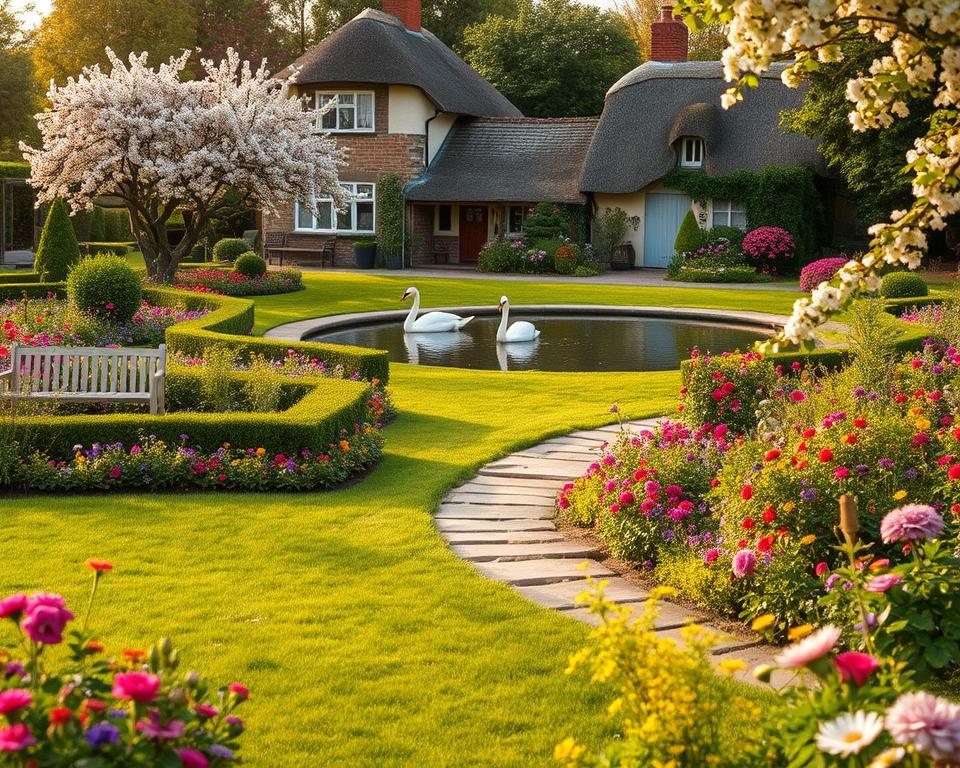
Seasonal drama and planting
Train roses over trellis and arches to add scent and height. Choose long-flowering delphiniums and lupins for vertical impact, then repeat a restrained palette so borders read as a unified whole.
“Plan deep borders, keep lawns generous and use classic ornaments to anchor the scene.”
- Plan layered perennials anchored with shrubs for year-round form.
- Use lawns and wide paths to give breathing space between rich planting.
- Commit to seasonal care—staking, deadheading and dividing—for lasting beauty.
| Feature | Benefit | Small plot tip |
|---|---|---|
| Herbaceous borders | Rich summer colour | Deep pots or narrow beds |
| Topiary & hedges | Winter definition | Use clipped box alternatives |
| Roses & trellis | Vertical scent | Train on narrow arches |
Design that reflects your home: linking house architecture and garden materials
A garden that feels right begins with the home’s materials and a simple palette carried outdoors. Start by matching brick tones, roof textures and key interior finishes so the outside reads as an intentional room rather than an afterthought.

Hard landscaping cues: brick, stone and façade colours
Echo the façade in paving and walling to create cohesion. Use the same brick type for paths or borders, or pick a complementary stone for terraces and steps.
- Pull façade colours into painted gates, pots and trim for subtle reinforcement.
- Limit hardscape to two or three materials repeated across larger areas for calm unity.
- Repeat small details—brick bands or setts—to link paths, steps and terraces.
Furniture and details: from Lutyens benches to mid-century lines
Choose furniture that suits the era of your home. Lutyens benches sit well with Edwardian houses, while clean, mid-century lines suit 1960s properties.
Link interiors and exteriors by carrying flooring tones or metal finishes onto the patio so rooms flow together.
| House era | Hard cue | Furniture |
|---|---|---|
| Edwardian | Reclaimed brick | Lutyens bench |
| 1960s | Sleek stone | Mid-century seating |
| Unadorned homes | Interior floor matched to patio | Simple timber pieces |
Outdoor room and urban gardens: liveable spaces for city homes
A successful outdoor room in the city treats every square metre as valuable and versatile. It places hard landscaping and furniture first, then fits planting around those elements so the area feels like an extension of your home.
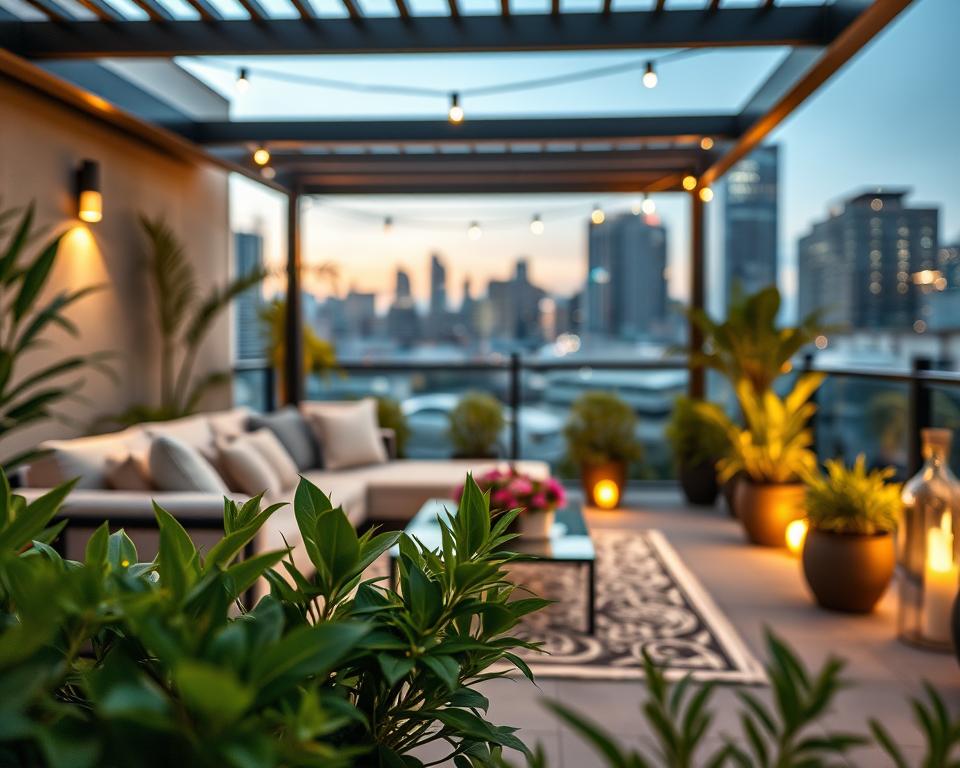
Think multifunctional edges and compact cooking with layers of heat and light for year-round use. Raised beds can double as seating and define rooms. Bench seating often hides storage, keeping tools and cushions tidy.
Space-smart features
- Multifunctional elements: raised bed edges at seat height, storage benches and foldaway furniture to free floor area.
- Vertical use of walls for climbers, mirrors and shelves keeps the plot uncluttered.
- Modular planters and wheeled pots let you reconfigure space for guests.
Cooking, heating and lighting outdoors
Fit a compact outdoor kitchen or pizza oven with correct clearances and ventilation. Add a flued stove or fire bowl for warmth and a layered lighting plan for tasks, ambience and safe routes.
“Contemporary town plots by designers like Charlotte Rowe often squeeze maximum function from small footprints while keeping planting lush but controlled.”
- Choose durable, low-maintenance surfaces that withstand urban wear and are easy to clean.
- Keep planting bold but simple: a limited palette avoids visual clutter in tight space.
- Design for drainage and accessible services to avoid trailing leads and awkward plumbing.
- Brief a designer with clear must-have functions so every centimetre works hard.
Contemporary and modern gardens: clean lines, controlled planting
Contemporary plots favour bold geometry and pared-back planting to create calm, intentional spaces. You should prioritise clarity of form and the quality of finish. Innovative materials and tight planting give a modern feel while keeping maintenance manageable.
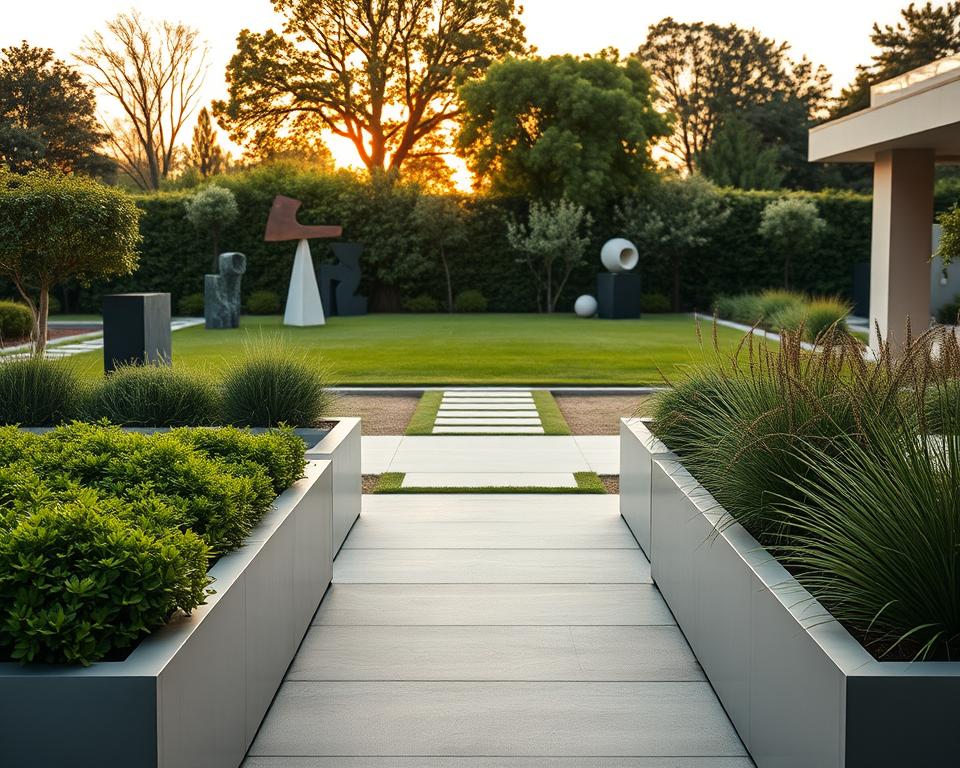
Geometry and materials: corten steel, gabions, crisp paving
Use strong geometry and consistent jointing patterns to deliver the crisp, modern feel. Specify corten steel for planters or edging and gabions for retaining walls to add an architectural texture. Choose paving with straight joints and narrow grout lines for that precise look.
Planting approach and colours
Limit species to a tight palette (often 12–20 plants) and repeat blocks for clarity. Rely on foliage contrast—greens and silvers—with one accent colour for composure. This restrained approach keeps the planting readable year-round.
Water features and pots
Employ calm water features—reflective planes or shallow rills—to avoid visual noise. Large, simple pots with sculptural silhouettes act as anchors; repeat them to create rhythm. Hide services and plan maintenance access from the start for a neat finish.
- Lighting: graze textures with wall washes and step lights rather than ornate fittings.
- Detailing: immaculate mitres, drainage slots and coping edges define success.
- Balance: pair hardscape mass with evergreen plants to avoid winter starkness.
| Element | Material | Practical tip |
|---|---|---|
| Planters & edging | Corten steel | Specify hidden fixings; weathering creates warm tones |
| Retaining | Gabions | Use stone fill that complements paving colours |
| Water feature | Reflective rill or plane | Minimise turbulence; allow for easy cleaning |
| Pots & lighting | Large ceramic/stone; recessed LEDs | Repeat forms; choose warm white light |
Mediterranean or dry gardens: drought-resilient style for low rainfall areas
Dry schemes use heat-retaining materials and tough, sun-loving plants to give long, low-maintenance interest.
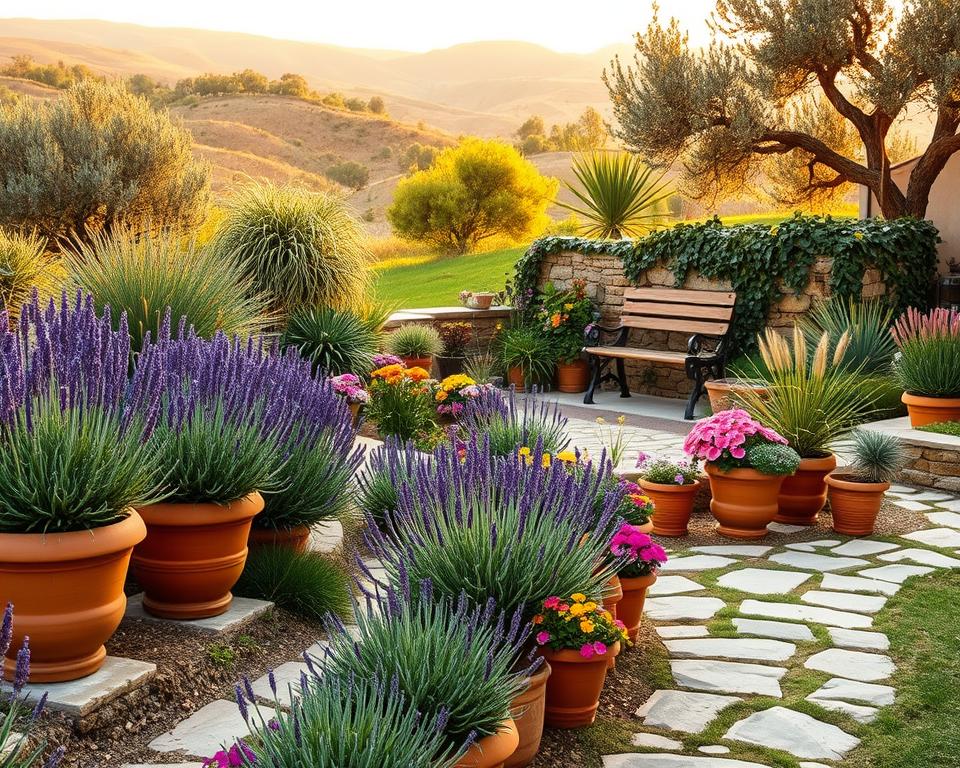
Choose drought-tolerant plants such as rosemary, lavender, succulents, ornamental grasses and verbascum. These species cope with low water and reflect light with silver foliage. Establish them with careful watering in year one, then reduce irrigation.
Use gravel mulch over free-draining soil to cut evaporation, suppress weeds and help self-seeding. Replace high-input lawns with paving, gravel or drought-tolerant groundcovers and add stone and terracotta to hold heat.
- Group plants by water need and crown slightly proud for winter drainage.
- Expect more weeding while gravel settles; maintenance falls as planting knits in.
- Avoid full dry schemes in very wet UK areas; adapt the palette to hardier perennials instead.
| Surface | Benefit | Practical tip |
|---|---|---|
| Gravel mulch | Reduces evaporation | Weed regularly at first |
| Stone & terracotta | Retains heat | Place near seating |
| Minimal lawns | Low input | Replace with drought-tolerant groundcover |
Coastal gardens: wind-hardy, salt-tolerant planting and beach textures
Wind and salt shape every choice you make when planting near the shore. Think fast-draining substrates, hardy species and materials that weather well. If you live a few streets back, salt spray lessens and your plant options widen.

Planting into gravel, shingle or sand
Plant directly into gravel, shingle or sandy loam to aid drainage and root resilience. Choose low-growing, wind-tolerant plants and favour those with salt tolerance for nearshore plots.
- Use permeable windbreaks rather than solid fences to reduce turbulence.
- Arrange decking and hardwoods that age attractively alongside galvanised fixings.
- Simplify palettes to soft greys, blues and sandy tones to suit maritime light.
- Keep irrigation minimal; pick species that handle brief drought and gusts.
- Elevate containers on pot feet and use marine-grade lights and fixings.
| Element | Benefit | Practical tip |
|---|---|---|
| Substrate | Rapid drainage | Use shingle or sandy loam for planting |
| Materials | Weathering charm | Hardwoods, galvanised metal, pebbles |
| Ornaments | Seaside character | Rope, driftwood, upcycled items |
Exotic or jungle gardens: layered foliage and bold forms
Dense, layered planting with oversized leaves and textured trunks gives a small plot an instant tropical feel. This approach uses canopy and mid-storey to create shade and humidity so seating feels sheltered and private.
Structure and shelter
Trees and layered underplanting
Start with hardy trees to form a canopy, then add shrubs and lush groundcovers beneath. Place a tree fern or small palm where it can cast dappled shade over a seating nook.

Cold-weather care and planting protection
Lift tender tubers like dahlias for winter and insulate crowns of borderline-hardy species. Use fleece, heavy mulch and rain covers in cold snaps.
- Pack plants close to raise humidity and reduce weeds.
- Weave narrow, meandering paths to enhance discovery.
- Use a small greenhouse to extend your plant palette.
| Feature | Benefit | Practical tip |
|---|---|---|
| Canopy trees | Shade and shelter | Choose compact species for small plots |
| Bold foliage | Instant tropical feel | Mix textures, not just colour |
| Winter protection | Plant survival | Store tubers; use fleece and mulch |
Feeding and finishing — feed generously in the growing season; bold leaves paired with a few bright flowers give accents rather than overwhelm. These tips help you bring a small patch of the exotic world to your own garden.
Japanese gardens: balance, pruning craft and mindful simplicity
A Japanese approach pares compositions back until each stone and plant has a clear role. You shape space by removing excess and letting voids frame key views. This restraint is the core of the aesthetic and the maintenance rhythm it demands.

Core principles
Asymmetry, negative space and texture guide every choice. Edit hard and soft elements to essentials so empty space becomes part of the composition.
Planting and trees
Borrow ikebana thinking: compose groups in an asymmetrical triangle—high, middle and low. Select a few specimen trees and shrubs and prune them meticulously to show structure rather than mass.
Water and authentic materials
Water features such as a still pond or a gentle cascade should sit so you can hear and see them from seating. Use timber, bamboo and aged stone; let lichen and moss add patina rather than fighting it.
“Keep colour minimal; rely on green tones, bark and foliage contrast with a single accent.”
- Edit to essentials so each element reads clearly.
- Use gravel, moss and aged stone for layered texture.
- Align paths to slow movement and present framed views.
- Maintain regularly: pruning, raking and moss care keep the intended beauty.
Wildlife-friendly gardens: beauty with habitat, water and no chemicals
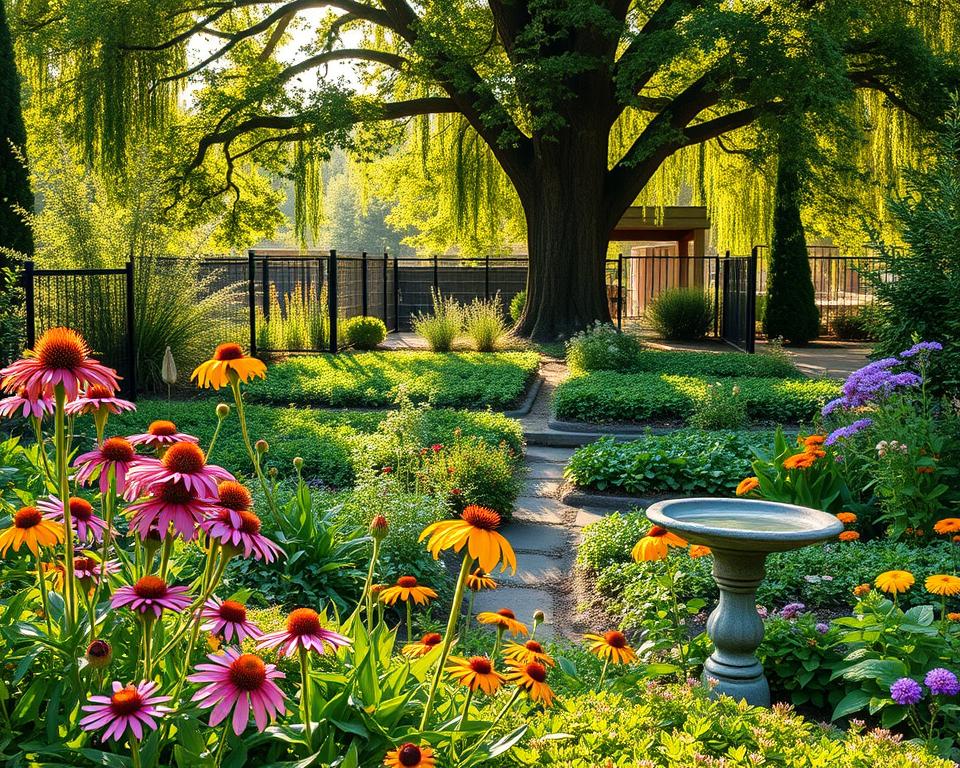
Invite wildlife in by offering simple resources—food, water and shelter—to make your outdoor space teem with life. Small, well-placed features have big ecological returns and add year-round beauty to your plot.
Food, water and shelter
Provide water with a small pond or shallow bowl and a beach entry so creatures can drink and leave safely. Plant nectar-rich flowers and shrubs that set seed and berries for winter food.
Shelter matters: leave log piles and leaf heaps in quiet corners and fit bird, bee and bat boxes where they will be undisturbed. Add hedgehog gaps at fences to link neighbouring plots.
Healthy soil and low inputs
Feed the soil, not pests. Mulch annually with compost or well-rotted manure to nurture microbes; a teaspoon of healthy soil hosts immense life that supports resilient plants.
Stop routine pesticide use and let natural predators control pests. Let a corner grow a little wilder to boost habitat diversity for invertebrates and amphibians.
“Small features create corridors of life across streets when neighbours join in.”
| Measure | Benefit | Quick tip |
|---|---|---|
| Small pond/water bowl | Drinking & breeding habitat | Include sloping edge for exits |
| Log piles & leaf litter | Invertebrate shelter | Keep in quiet, shaded spot |
| Annual compost mulch | Improves soil biology | Apply 2–5cm around plants |
Naturalistic and prairie planting: grasses, perennials and seasonal movement
Naturalistic planting borrows movement from large public schemes and adapts it to smaller plots. Drifts of grasses and perennial blocks bring texture, sway in the wind and long seasons of interest. You can mirror the High Line’s sense of flow while keeping scale and maintenance suitable for your garden.

Design cues from public to domestic
Look to public landscape projects for compositional cues, not exact plant lists. Use massing, repetition and clear paths to create breadth in confined areas. Choose a restrained palette and repeat blocks so beds read as a single composition.
Maintenance rhythms and winter seedheads
Build communities of compatible perennials and ornamental grasses that suit your soil and light. Plant in layers—structural perennials, theme plants and seasonal fillers—to give constant movement and shelter for wildlife.
- Pick species with lasting seedheads and sturdy stems to stand through winter.
- Space generously at first; initial weeding and editing reduce inputs later.
- Cut back in late winter rather than autumn to preserve habitat and winter silhouette.
- Edge beds with low-mow strips or steel for tidy boundaries around looser planting.
| Element | Benefit | Practical tip |
|---|---|---|
| Massing | Strong visual rhythm | Repeat groups across areas |
| Seedheads | Winter interest & habitat | Leave until late winter |
| Anchors | Year-round focus | Use boulders or simple stakes |
For gardeners, this approach offers low inputs once established and constant seasonal inspiration. Scale public ideas to your plot and you’ll achieve natural movement without excess maintenance, aligning modern planting with familiar British tastes and contemporary styles.
Rock, mountain and alpine gardens: sculptural stone and tight planting
A small alpine corner can read like a miniature mountain if you copy natural stone rhythms. Victorian collectors popularised rockeries and alpine features, and their approach still guides planting and composition today.

Alpine schemes rely on superb drainage and careful stone placement to keep diminutive plants healthy. Scree beds and raised, gritty soil mimic mountain runoff and stop winter wet from rotting crowns.
Stone placement, scree beds and drainage
Set larger stones deep on their natural bedding planes so they sit authentically and resist movement. Arrange rocks to form crevices for shade and warm pockets for sun lovers.
- Build free-draining scree or raised beds with sharp grit to protect alpines from waterlogging.
- Choose compact, sun-loving plants adapted to lean soils and rapid runoff.
- Keep features small-scale in town areas; a few well-placed boulders read better than many pebbles.
- Top-dress with grit, weed regularly and replace short-lived alpines as needed.
- Provide winter rain protection for the most sensitive species with cloches or cold frames.
“Use materials that echo local geology so the composition feels of the place.”
| Element | Benefit | Quick tip |
|---|---|---|
| Large stones | Stability and scale | Bed deep on firm plane |
| Scree bed | Free drainage | Use sharp grit, not fine sand |
| Small rill/basin | Subtle water feature | Only where drainage avoids pooling |
Native and eco-friendly approaches: sense of place and lower inputs
Let the local soils and wildlife guide your choices so the plot becomes kinder to nature and easier to manage.

Native plants for pollinators and resilience
Use locally adapted species to support bees, hoverflies and birds. Native plants need less feeding and cope better with local pests and seasons.
Set aside wild margins and mix nectar-rich perennials with shrubs to create layered habitat that suits small urban and larger rural garden areas.
Permeable paths, rain capture and soil-first practices
Keep water on site with rain gardens, swales and water butts to reduce runoff and help recharge soil.
Feed the soil with organic mulches and compost and avoid synthetic fertilisers where possible. Choose low-carbon materials or reclaimed products for hardscaping.
- Match irrigation to establishment only; move to drought-tolerant planting once set.
- Leave dead wood and create habitat layers for invertebrates, birds and bats.
- Mow less and set aside wild areas to boost biodiversity.
- Share your plant lists and results with neighbours—small corridors help wildlife at street scale.
Monitor outcomes and tweak species mixes as you learn; practical, local changes reward both wildlife and gardeners.
Garden style through history: eras that shaped today’s designs
Each era left clear fingerprints—forms, plants and rituals—you can use when planning your plot today.
Medieval
Enclosed quarters used wattle or quickthorn and trellis walks to shelter beds.
Raised physic herbs, orchards, turf seats and stew ponds mixed devotion and utility.
Tudor
Low box-edged knot patterns and mounts created theatre for banquets.
Fountains, automata and heraldic ornaments signalled status and taste.
Stuart
French and Dutch formality introduced terraces, parterres, avenues and disciplined topiary.
Canals and fountains emphasised axial features and long views.
Georgian
Design moved towards an Arcadian landscape with lakes, cascades, temples and the ha-ha.
Clumps, shrubberies and sweeping walks framed prospect and privacy.
Victorian
Plant collecting from across the world fed arboretums, glasshouses and bright bedding schemes.
Rockeries and the ‘wild garden’ reacted against industrial monotony.
20th century
Garden rooms, colour-led borders and prairie plantings layered modern use and perennial movement.
Trees and lawns stayed as structural constants while new elements were tried.

| Era | Signature | Quick tip |
|---|---|---|
| Medieval | Herb beds & orchards | Use enclosures for microclimate |
| Georgian | Lakes & ha-has | Frame long views with clumps |
| Victorian | Glasshouses | Mix exotics with native trees |
“Many current features—parterres, garden rooms and meadows—trace directly to these eras.”
Understanding past styles helps you reference history with authenticity and adapt timeless ideas for your own garden.
Paths, stone and water features: unifying elements across styles
Paths and water bodies are the threads that stitch different parts of an outdoor plot into a single, readable plan. Use them to link rooms, frame views and set the mood for the wider scheme.

Lines and surfaces: gravel, brick, stepping stones and edging
Set widths to suit how you move and what you carry; a main route needs more clearance than a narrow stroll path.
Consistent lines and neat edging keep planting tidy and guide movement. Mix textures—brick bands in gravel or stone flags with setts—to add grip and detail underfoot.
Align key routes with focal points so views reward you at path termini. Choose materials that weather well and match local vernacular.
Ponds, rills and fountains: siting, materials and reflections
Locate a pond where it catches light and is visible from seating and inside the house. Reflection works best where trees and sky can be read on the surface.
Decide early if you want wildlife or crisp reflection; depth and finish differ for each aim. Gentle rills move water through a plot without overwhelming small spaces.
“Place water to be seen and heard from the main living areas for greatest effect.”
- Use consistent lines and edging to tie steps, terraces and paths together.
- Build discreet drainage so surfaces stay usable in wet UK seasons.
- Combine safety—non-slip finishes and child-safe pond depths—with visual intent.
From ideas to your plot: choosing the right style for your UK outdoor space
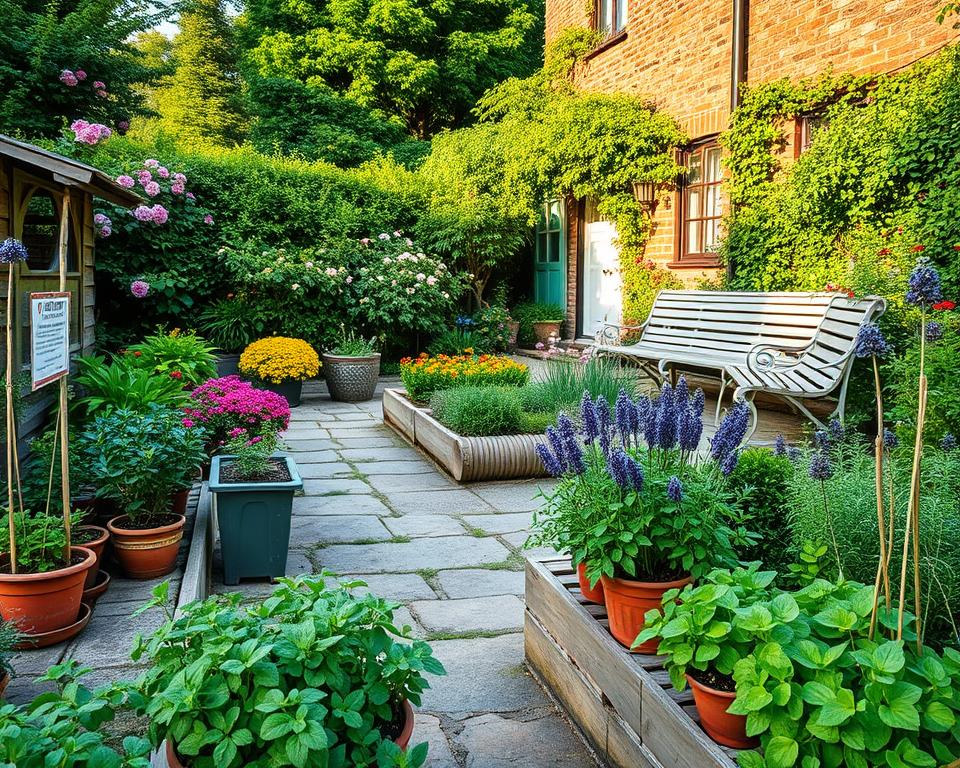
Start from the site: note shade pockets, prevailing wind and soil depth before committing to a plan. These simple checks save time and cost later.
Assessing climate, aspect, soil and the time you can give
Test soil with a spade and a jar, and record where sun and wind fall through the day. Match maintenance to your weekly routine.
If you have limited time, favour lower-input plants and hardier specimens. Prioritise structure—paths, hedges and a few trees—so the plot reads well even before perennials fill in.
Blending styles: coherent themes, colours and materials
Pick one lead approach and one secondary influence. Repeat two or three colours and a small palette of materials to tie inside to outside.
- Build a mood board and a plant list early to keep costs down.
- Phase the work: hardscape and services first, then trees and shrubs, then perennials.
- Sense-check sustainability — permeable surfaces and rain capture reduce long-term inputs.
| Stage | Priority | Quick action |
|---|---|---|
| Survey | Climate, aspect, soil | Note sun hours and soil type |
| Structure | Paths, trees, hedges | Install hardscape and utilities |
| Planting | Shrubs, perennials | Phase after shelter is in place |
“Many successful UK gardens adopt a primary approach with subtle accents from another.”
Use these practical ideas and tips to choose a coherent, sustainable scheme that fits your space and time. Review after a year and refine plant mixes for better performance.
Conclusion
Begin with the feeling you want when you step outside, then match materials and plants to your home and the UK climate. This simple rule makes procurement, layout and maintenance clearer and faster.
Blend a classic look with a condition-led approach so the scheme is both personal and resilient. You now have a clear view of the main styles and practical ideas to guide decisions at every stage.
Start with structure, then layer planting to suit maintenance, aspect and soil. Keep colours and materials consistent so different areas read as one coherent space.
Use wildlife-friendly practices across any approach to increase resilience and pleasure through the seasons. Treat the project as long term: test, refine after the first year and share progress with local gardening groups for extra support and inspiration.
FAQ
What are the main garden style categories and how do they differ?
You’ll find a wide range of approaches, from romantic cottage planting and formal, symmetrical layouts to contemporary schemes with clean lines, Mediterranean drought-tolerant beds, coastal planting and Japanese minimalism. Each type emphasises different elements — for example, formal designs use hedges, topiary and geometry; naturalistic schemes favour grasses and perennials; while Mediterranean and dry gardens prioritise drought‑resistant herbs, succulents and gravel surfaces.
How do you match a style to your space, climate and maintenance capacity?
Start by assessing aspect, soil, wind and rainfall, plus how much time you can spend on upkeep. South‑facing, low‑rain plots suit Mediterranean or xeriscape planting; shady, cool areas favour woodland or Japanese approaches. If you want low maintenance, choose native or prairie plantings, gravel mulch and minimal lawn. For high impact with moderate work, consider deep herbaceous borders or a cottage scheme with self‑seeding perennials.
What defines classic, condition‑led and historically influenced designs?
Classic designs emphasise order, symmetry and enduring materials — think parterres, terraces and formal hedges. Condition‑led approaches adapt to local site limits like poor drainage or exposure, using suitable plants and hard landscaping. Historical styles draw on past eras — Tudor knot gardens, Georgian lakes or Victorian rockeries — and can be adapted for modern use with contemporary materials.
What are the key elements of a cottage garden for small UK plots?
Focus on mixed, colour‑rich borders, herbs for scent and use, informal paths and reclaimed features such as benches or arches. Keep lawns small or omitted, use gravel or brick paths, and plant abundant self‑seeders like poppies, foxgloves, roses, lupins and delphiniums for seasonal interest.
Which materials and features suit a traditional, formal scheme?
Use clipped hedges, stone or brick paving, symmetrical beds, parterres and focal points such as urns, sundials or a statue. Topiary and tightly kept lawns provide winter structure; gravel paths, stone steps and low walls reinforce geometry and sightlines.
How do you create an English country look in a modern setting?
Combine deep herbaceous borders with sweeping turf, specimen shrubs and classic accents like urns or trellis. Use strong, informal drifts of perennials, roses on supports and clipped hedges for structure, while allowing seasonal change and wildlife value.
How should garden design reflect a house’s architecture?
Take cues from the façade: use matching brick, stone or colour palettes in paving and furniture. A period home may suit Lutyens benches and formal layouts; a mid‑century house benefits from simple lines, restrained planting and contemporary seating. Materials tied to the house create visual harmony between inside and out.
What are practical features for outdoor rooms and urban plots?
Maximise function with multi‑use elements: raised beds that double as seating, storage benches, vertical planting and compact water features. Include heating (a chiminea or gas firepit), layered lighting and durable surfaces for year‑round use in small spaces.
What distinguishes contemporary and modern schemes?
Contemporary gardens favour geometry, limited plant palettes, architectural pots and materials such as corten steel, gabions and crisp paving. Planting focuses on foliage texture and structure rather than abundant colour, and water features act as pared‑back focal points.
Which plants and surfaces suit Mediterranean or dry gardens in the UK?
Use drought‑tolerant herbs and shrubs — rosemary, lavender, santolina, verbascum and many grasses and succulents — combined with gravel mulch, stone paving and minimal lawn. Note that these perform best in sheltered, well‑drained spots and may need protection in colder, wet winters.
How do coastal conditions change planting choices?
Choose salt‑ and wind‑tolerant species and gritty soils: thrift, sea kale, grass mixes and low shrubs planted into gravel or shingle. Use robust materials, low profiles and sheltering walls or hedges to protect tender plants from salt spray and strong winds.
What are the essentials of exotic or jungle‑inspired schemes?
Layering is key: canopy trees, mid‑layer shrubs and bold architectural perennials beneath. Provide shelter, rich soil and humidity where possible, and plan winter protection for tender specimens with greenhouses, fleece or pots moved indoors in colder months.
What principles guide Japanese garden design?
Emphasise balance through asymmetry, negative space and texture. Use moss, gravel, clipped or carefully pruned trees, specimen planting influenced by ikebana and restrained water features. Materials should feel authentic — wood, stone and simple metals — and maintenance focuses on careful pruning.
How do you design a wildlife‑friendly outdoor space?
Provide food, water and shelter: ponds, berrying shrubs, log piles and nesting boxes support birds, bats and invertebrates. Promote healthy soil with compost and minimal chemical use, and include native plants to boost pollinators and resilience.
What is naturalistic or prairie planting and how much upkeep does it need?
Naturalistic schemes mix grasses and perennials in drifts to create seasonal movement and seedhead interest. They often require an annual cut‑back, selective weeding and occasional replanting but can be lower maintenance than intensive beds once established.
How are rock, alpine and mountain plots built for success?
Focus on sculptural stone, scree beds and excellent drainage. Choose compact, alpine species with tight root systems and site stones to create microclimates. These schemes work well on slopes or raised beds with gritty, free‑draining mixes.
Why choose native and eco‑friendly planting?
Native species support local pollinators, reduce input needs and enhance resilience. Complement them with permeable paths, rainwater capture and soil‑first practices to create low‑impact, habitat‑rich spaces that suit UK conditions.
How have historical eras shaped contemporary garden approaches?
Each era left legacies: medieval physic gardens and orchards, Tudor knot layouts, Stuart terraces and avenues, Georgian lakes and ha‑has, Victorian plant collecting and rockeries, and 20th‑century garden rooms and prairie influences. Designers borrow elements from these periods, adapting them to modern materials and lifestyles.
What unifies paths, stonework and water features across different schemes?
Lines and surfaces guide movement and sightlines, so choose materials that suit the overall theme — gravel and brick for rustic schemes, crisp paving for contemporary designs. Water features need careful siting for sound and reflection; rills, ponds or fountains act as focal anchors in many approaches.
How do you go from ideas to a workable plan for your UK plot?
Assess aspect, soil, microclimate and the time you can commit. Choose a coherent palette of materials and plants, consider blending compatible styles, and start with a phased plan to spread cost and labour. Consulting a landscape designer can help translate inspiration into practical drawings and plant lists.

